Research Article | | Peer-Reviewed

Biomimetic Avian-Marine Optimization: A Framework for Non-Functional Bio-Inspired Polymer Aerodynamic Decorative Installations

Received: 1 August 2026     Accepted: 11 August 2026     Published: 8 September 2026
Views:       Downloads:
Abstract

In this paper, we manufacture biomimetic avian-marine device for the first time. The structures are formed by understanding flying fish and planar wing integration. The plastic frustum gives bio inspired wing mechanics of flying fish. The modular readymade air plane provides the biomimetic avian structure. Here, we combine the liquid spray perfume to study solid-liquid placements. The liquid spray perfume are enclosed in plastic bottle. The liquid perfume are together with solid plastic tubes and plastic trees. The structural canvas are detailed with textile, plastic trays, plastic containers and polymers. The entire assembly are mounted on wood table. We do not use fluid networks. The biomimetic architecture are for decorative installations. Here we develop computer aided design (CAD) digital twin to 3D representation model of camera image. The model uses human perception method with the function call trimesh. The method provides the coordinates of the camera image in excel document. In this study, we develop python code to convert coordinates in excel to 3D model. We develop language model text to 3D objects. We develop artificial intelligence codecs that simple convert the language text to 3D objects. Our model are run on computer laptop. The simulation time is 45 s. The model matches the actual object. Our work can find applications in Augmented Reality (AR) exhibitions, generative mixed-media manufacturing, retail display design and bio-inspired material studies.

Published in International Journal of Mechanical Engineering and Applications (Volume 14, Issue 3)
DOI 10.11648/j.ijmea.20261403.12
Page(s) 60-67
Creative Commons

This is an Open Access article, distributed under the terms of the Creative Commons Attribution 4.0 International License (http://creativecommons.org/licenses/by/4.0/), which permits unrestricted use, distribution and reproduction in any medium or format, provided the original work is properly cited.

Copyright

Copyright © The Author(s), 2026. Published by Science Publishing Group

Keywords

Biomimetic, Modeling, Artificial Intelligence, Polymers

1. Introduction
Bio-inspired design, or biomimicry, traditionally focuses on transferring natural mechanics into functional engineering solutions. The nature inspired design and art towards mechanics are studied . The structures that emerge from the multi physics design are new . The advantage of multi physics technology to include plastics, metal alloys, liquid perfume sprays, textiles, polymers and ceramics opens the topic in easy settings. The benefits of the structures should range in large medium of comforts . Regional installation of fibrous polymers able the new landscape in modern ways . The scope of packaging materials from the microscopic to bulk scale installation provides the ability to selection of periodic elements in the economic regime and environment. There are studies in India towards outdoor and domestic land use towards uplift of economy. Recent studies show the merge mechanics of robot and animals . The steps to integrate in the facility of landscape shows the promise of engineering compatibility to shapes, structures and elements .
The language to computer aided design from actual image to model needs thorough establishments. The text to image and digital twin to replica actual objects are looked in detail . The precise twin in virtual model completes the establishment to provide structures in city domain. Bio inspired design welcome the notion from 3D complex structures. The digital twin of graphene membranes are studied . Artificial intelligence (AI) emergence to design and contribute in the computer aided design language are advantageous to the wide applications . The ai models offers human direct language and have reduced the lines of code. The codecs are studied with python for the solid, liquid and gas domains. The sheet, rolls and nature inspired complex structures are provided in the virtual model with elements to develop the city and enhance the environment.
In this paper we provide benchtop set up of biomimetic flying fish and wing objects. The framework integrates rigid polymer aircraft models, passive fluid containers, and contrasting textile textures into a cohesive visual ecosystem that mirrors the transitional nature of avian-marine organisms. We study liquid perfume sprays. The plastic tree and tubes are in contact with the liquid. The liquid, plastic trees and the solid tubes are enclosed in the bottle. The bottle material are transparent plastics. By utilizing the spray-applied fluid boundaries, we can visually monitor real-time boundary layer transition delays and fluid separation zones directly across the multi-environment profiles of the liquid perfume bottle. In this study we model the biomimetic structures. We develop digital twin. The computer aided design 3D model matches the actual object for the first time. Our work can find applications to build low cost airports. They are built in less traffic regions. The biomimetic design provide coordinates to the micro–aerial vehicles (MAVs). The wing design provides bio design for fins.
2. Materials and Methods
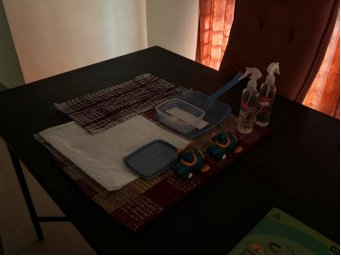
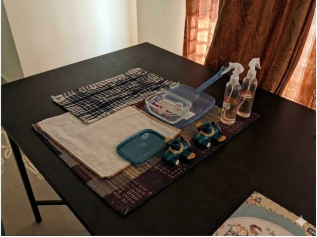
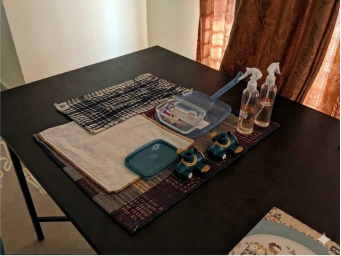
The two airplanes are purchased from Hamleys, India. The liquid spray perfumes are purchased from Home center, India. The liquid perfume have plastic tube and plastic trees. They are bio compatible. We use two liquid perfumes. The plastic frustum are purchased from Murugan stores, India. The textile, polymers and plastic containers are provided from Indian Institute of Technology Madras facility. Figure 1 shows the biomimetic structure.
Figure 1. Manufacture of decorative assembly that are inspired from biomimetic design.
3. Computer Aided Design
3.1. Human Perceptron Method
Human perceptron method uses the in built function of trimesh in python. Trimesh gives the map of the coordinate locations of the object. The object in our model is the upload image. The approach of trimesh are similar to understand face coordinates to replica the features of the human face that include eyes, nose and mouth. The trimesh and python import software have the adjustments of colors over the years. We save the coordinates of the object in excel file.
import cv2
import numpy as np
import os
import trimesh
import pandas as pd
def build_clean_industrial_twin(image_path, obj_output="figure_1a_twin_clean.obj", jpg_output="figure_1a_twin_render_clean.jpg", excel_output="figure_1a_twin_data.xlsx"):
if not os.path.exists(image_path):
print(f"\n[ERROR] Could not find file: '{image_path}'")
return
print("\n==== PHASE 1: Generating Cleaned 3D Surface ====")
color_image = cv2.imread(image_path)
h, w, _ = color_image.shape
# Pre-processing and aggressive blur to eliminate rough pixelation spikes
filtered_color = cv2.bilateralFilter(color_image, d=9, sigmaColor=75, sigmaSpace=75)
gray_image = cv2.cvtColor(filtered_color, cv2.COLOR_BGR2GRAY)
color_image_rgb = cv2.cvtColor(filtered_color, cv2.COLOR_BGR2RGB)
# 1. Background Masking: Identify the dark wooden table surface
_, thresh = cv2.threshold(gray_image, 45, 255, cv2.THRESH_BINARY)
mask = cv2.GaussianBlur(thresh.astype(float) / 255.0, (15, 15), 0)
# 2. Compute Height Map and force background table to flat 0.0 ground plane
normalized_height = 255.0 - gray_image
depth_metric = (normalized_height / 255.0) * 0.4 # Max height 40cm
depth_metric = depth_metric * mask # Multiplied by mask to zero out the table spikes!
# Generate 3D grid vectors
x, y = np.meshgrid(np.arange(w), np.arange(h))
focal_length = max(w, h)
x_3d = (x - w / 2) * 1.5 / focal_length
y_3d = (y - h / 2) * 1.5 / focal_length
z_3d = depth_metric
vertices = np.stack((x_3d, y_3d, z_3d), axis=-1).reshape(-1, 3)
vertex_colors = color_image_rgb.reshape(-1, 3)
print("Triangulating structural layout faces...")
faces = []
for i in range(h - 1):
for j in range(w - 1):
v0 = i * w + j
v1 = v0 + 1
v2 = (i + 1) * w + j
v3 = v2 + 1
faces.append([v0, v2, v1])
faces.append([v1, v2, v3])
faces = np.array(faces)
# Compile mesh and clean floating edge pieces
twin_mesh = trimesh.Trimesh(vertices=vertices, faces=faces, vertex_colors=vertex_colors)
twin_mesh.remove_unreferenced_vertices()
# Save the 3D asset
twin_mesh.export(obj_output)
print(f"-> SUCCESS: Cleaned 3D Model file saved to: {obj_output}")
# -------------------------------------------------------------------------
# PHASE 2: INSTANT OPENCV SHADED RENDERING
# -------------------------------------------------------------------------
print("\n==== PHASE 2: Rendering Cleaned Perspective Snapshot ====")
grad_x = cv2.Sobel(depth_metric, cv2.CV_64F, 1, 0, ksize=3)
grad_y = cv2.Sobel(depth_metric, cv2.CV_64F, 0, 1, ksize=3)
shading = np.sin(np.arctan(np.sqrt(grad_x**2 + grad_y**2)))
shading = (shading - shading.min()) / (shading.max() - shading.min() + 1e-5)
shading = 0.3 + 0.7 * shading # Ambient lighting boost
shaded_colors = (color_image_rgb.astype(float) * shading[:, :, None]).astype(np.uint8)
shaded_colors_bgr = cv2.cvtColor(shaded_colors, cv2.COLOR_RGB2BGR)
cv2.imwrite(jpg_output, shaded_colors_bgr)
print(f"-> SUCCESS: Cleaned Render snapshot saved to: {jpg_output}")
# -------------------------------------------------------------------------
# PHASE 3: INTEGRATED INDUSTRIAL DATA LOG EXPORT TO EXCEL
# -------------------------------------------------------------------------
print("\n==== PHASE 3: Exporting Structural Data Matrices to Excel ====")
print("[1/2] Converting coordinate meshes to spreadsheet arrays...")
# Step interval downsamples size to keep sheets optimized and highly readable
step_interval = 4
x_log, y_log, z_log = [], [], []
r_log, g_log, b_log = [], [], []
for r_idx in range(0, h, step_interval):
for c_idx in range(0, w, step_interval):
# Log structural positions relative to center baseline points
x_log.append(c_idx - w // 2)
y_log.append(h // 2 - r_idx)
# Map clean relative height profile conversions in centimeters
z_log.append(round(depth_metric[r_idx, c_idx] * 100.0, 2))
# Append individual color profile signatures
r_val, g_val, b_val = color_image_rgb[r_idx, c_idx]
r_log.append(r_val)
g_log.append(g_val)
b_log.append(b_val)
# Structure database values
twin_dataframe = pd.DataFrame({
"Spatial_X_Position": x_log,
"Spatial_Y_Position": y_log,
"Structural_Height_cm": z_log,
"Color_Channel_Red": r_log,
"Color_Channel_Green": g_log,
"Color_Channel_Blue": b_log
})
print(f"[2/2] Writing data values to worksheet...")
twin_dataframe.to_excel(excel_output, index=False, sheet_name="3D Twin Height Log")
print(f"-> SUCCESS: Data spreadsheet matrix saved to: {excel_output}")
print("\n=======================================================")
print("Pipeline Complete! The spikes have been flattened and logs saved.")
print("=======================================================")
if __name__ == "__main__":
# Corrected function call to perfectly match the defined name above
build_clean_industrial_twin("figure 1 a.jpg", "figure_1a_twin_clean.obj", "figure_1a_twin_render_clean.jpg", "figure_1a_twin_data.xlsx")
Figure 2 shows the digital twin model of the biomimetic actual structure. Digital twin is a computer model. They are also virtual objects. We upload the image of the actual object. The codes are written to obtain the model. The simulation time is 45 s. We run the python code in our laptop. The model matches the actual object.
Figure 2. Digital twin of biomimetic structure.
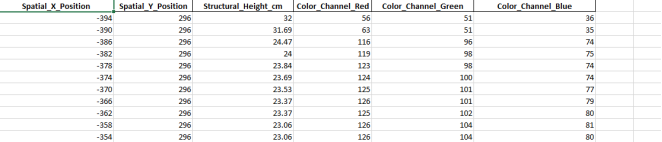
Figure 3 shows the excel file. We have few lines of all the row coordinates. The excel file size is 754 KB.
Figure 3. Excel document.
3.2. Rebuild from Excel File the Software Model Output
Code
import cv2
import numpy as np
import os
import pandas as pd
def rebuild_image_from_specific_excel(excel_path="figure_1a_twin_data.xlsx", output_jpg_path="rebuilt_from_excel.jpg"):
# -------------------------------------------------------------------------
# SAFETY GUARD: Check if Excel exists in current folder
# -------------------------------------------------------------------------
if not os.path.exists(excel_path):
print(f"\n[ERROR] Could not find your spreadsheet file: '{excel_path}'")
print(f"The script is looking inside this folder: {os.path.abspath(excel_path)}")
print("Please verify the file name is spelled exactly correctly.\n")
return
print(f"[1/3] Extracting structural matrices from '{excel_path}'...")
# Read the data rows using pandas engine
df = pd.read_excel(excel_path, sheet_name="3D Twin Height Log")
# Reverse engineer grid bounds by tracking unique position arrays
unique_x = np.sort(df["Spatial_X_Position"].unique())
unique_y = np.sort(df["Spatial_Y_Position"].unique())[::-1] # Invert Y back to standard image layout
w_grid = len(unique_x)
h_grid = len(unique_y)
print(f"-> Found Grid Dimensions: {h_grid} rows x {w_grid} columns ({len(df)} total data nodes).")
print("[2/3] Reconstructing spatial color and depth surfaces...")
# Initialize empty base arrays to hold structural variables
depth_metric = np.zeros((h_grid, w_grid), dtype=np.float64)
color_image_rgb = np.zeros((h_grid, w_grid, 3), dtype=np.uint8)
# Map geometric locations to indices via lookup dictionaries for rapid speed loops
x_to_col = {x_val: idx for idx, x_val in enumerate(unique_x)}
y_to_row = {y_val: idx for idx, y_val in enumerate(unique_y)}
# Map spreadsheet data fields back into image matrices
for _, row in df.iterrows():
r = y_to_row[row["Spatial_Y_Position"]]
c = x_to_col[row["Spatial_X_Position"]]
# Recalculate physical elevation back to standard relative depth units
depth_metric[r, c] = row["Structural_Height_cm"] / 100.0
# Remap RGB texturing
color_image_rgb[r, c] = [
int(row["Color_Channel_Red"]),
int(row["Color_Channel_Green"]),
int(row["Color_Channel_Blue"])
]
print("[3/3] Re-applying surface shading and exporting picture...")
# Measure structural slope change rates via Sobel convolution grids
grad_x = cv2.Sobel(depth_metric, cv2.CV_64F, 1, 0, ksize=3)
grad_y = cv2.Sobel(depth_metric, cv2.CV_64F, 0, 1, ksize=3)
# Build surface contrast shadow vectors
shading = np.sin(np.arctan(np.sqrt(grad_x**2 + grad_y**2)))
shading = (shading - shading.min()) / (shading.max() - shading.min() + 1e-5)
shading = 0.3 + 0.7 * shading # Ambient boost to match bright workshop lighting
# Overlay shaded matrix curves onto our color arrays
shaded_colors = (color_image_rgb.astype(float) * shading[:, :, None]).astype(np.uint8)
shaded_colors_bgr = cv2.cvtColor(shaded_colors, cv2.COLOR_RGB2BGR)
# Upsample pixels up smoothly via cubic interpolation to remove pixelation noise blocks
final_output_img = cv2.resize(shaded_colors_bgr, (w_grid * 4, h_grid * 4), interpolation=cv2.INTER_CUBIC)
# Save image
cv2.imwrite(output_jpg_path, final_output_img)
print(f"\n[SUCCESS] Image successfully rebuilt from Excel columns at:\n--> {os.path.abspath(output_jpg_path)}")
if __name__ == "__main__":
rebuild_image_from_specific_excel()
Output image
Figure 4 shows the computer model biomimetic structure. We obtain the model image from the coordinates of the upload image. The upload image is the camera image of the actual structure. The coordinates are stored in excel file. The simulation time is 35 s. The model matches the actual object.
Figure 4. Rebuilt computer aided design biomimetic structure from excel file only.
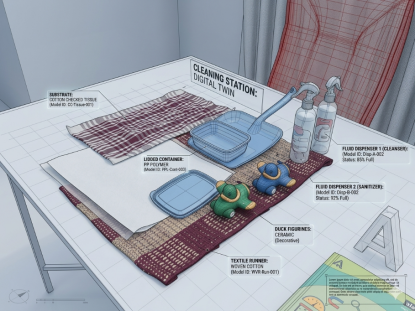
3.3. Language Model Text to 3D Objects
We use the text to image model by typing in the google ai mode software. The command lines given by us are here. We use nano banana image technology.
The text written by us: We provide the upload camera image. We want 3D digital twin art. Give 3D image.
Figure 5 shows the 3D model developed from the language method.
Figure 5. Digital twin art 3D object obtained from language model text.
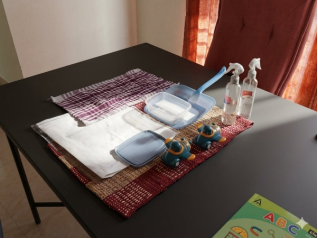
3.4. Artificial Intelligence Codec Text to Image Model
We then develop artificial intelligence codec command lines that are given here. We use google ai mode online software.
The text written by us: Step 1: upload camera image. Step 2: give 3D image.
Figure 6 shows the 3D model developed from the artificial intelligence codec text method. The model matches the actual object.
Figure 6. Computer aided design artificial intelligence method to model biomimetic structure. We use nano banana image technology.
We have to mention that we need to obtain the excel document having the coordinates of the codec method in our future work. The coordinates to 3D model needs further study. In this way we should integrate nano banana image technology to excel and python software. They provide the pixel generation software for broader applications.
4. Results and Discussion
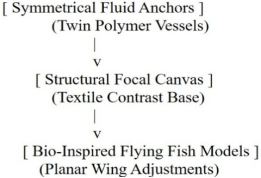
To achieve an authentic bio-inspired look without mechanical parts, the structural design leverages the physical principles of the flying fish. The schematic representation of the parts of the biomimetic architecture are given in Figure 7. The symmetrical fluid anchors are the two liquid perfume sprays. The liquid perfume spray are enclosed in plastic bottle. The liquid perfume spray also contain in them solid tubes and plastic trees. The polymer, textile and plastic containers represent the structural focal canvas. We have flying fish bio-inspired structure and planar wing airplanes. Figure 1. shows the biomimetic structure.
Figure 7. Schematic representation of the biomimetic architecture.

5. Conclusion
To conclude we study biomimetic structures. We manufacture bio inspired aviation–marine device for decorative structures. The components are purchased. The structure consists of plastic frustum that represents flying fish and modular plastic air planes. We integrate transparent plastic containers, textile and polymers to build our architecture. We use liquid spray perfume to understand the combine rule of solids and liquids. We develop computer aided design 3D model. Here we use trimesh to wrap the object, divide to channel domains and provide coordinates. The coordinates provide the 3D software image. The model matches the actual structure. We develop artificial intelligence codecs that use text to 3D model. The simulation are run on computer laptop. Our work provides balanced harmony between natural form and industrial material.
Abbreviations

CAD

Computer Aided Design

AR

Augmented Reality

AI

Artificial Intelligence

MAVs

Micro–Aerial Vehicles

Author Contributions
Nandigana Venkata Raghavendra Vishal: Conceptualization, Data curation, Formal Analysis, Investigation, Methodology, Resources, Software, Supervision, Validation, Visualization, Writing – original draft, Writing – review & editing
Conflicts of Interest
The author declares no conflict of interest.
References
[1] Armistead, S. J., Maierdan, Y., Carcassi, O. B., Mikofsky, R. A., Kawashima, S., Ben-Alon, L., Srubar, W. V., Bio–inspired 3D–printed earthen materials and structures, Nature Communications. 2026, 17, 1–12.
[2] Wegst, U. G. K., Bai, H., Saiz, E., Tomsia, A. P., Ritchie, R. O., Bioinspired structural materials, Nature Materials, 2015, 14, 23–36.
[3] Dziedzic, M., Njoya, E. T., David, W. S., Hubbard, N., Determinants of air traffic volumes and structure at small European airports, Research in Transportation Economics, 2020, 79, 100749.
[4] Adler, N., Ulku, T., Yazhemsky, E., Small regional airport sustainability: Lessons from benchmarking, Journal of Air Transport Management, 2013, 33, 22–31.
[5] Schiller, T., Scheibel, T., Bioinspired and biomimetic protein-based fibers and their applications, Communications Materials, 2024, 5, 1–18.
[6] Tonndorf, R., Aibibu, D., Cherif, C., Collagen multifilament spinning, Materials Science and Engineering: C, 2020, 106, 1–11.
[7] Schiros, T. N., Mosher, C. Z., Zhu, Y., Bina, T., Gomez, V., Lee, C. L., Lu, H. H., Obermeyer, C. A. C., Bioengineering textiles across scales for a sustainable circular economy, Chem, 2021, 7(11), 2913–2926.
[8] Schmuck, A., Bele, T. G. A., Withoeck, D., Van Geem, K. M., Ragaert, K., Meester, S. D., Analysis of trade-offs of post-sorting plastic packaging, Nature, 2026, 654, 383–390.
[9] Dziendzikowska, K., Czerwińska, M., Grodzicki, W., Oczkowski, M., Krolikowski, T., Ostrowska, J. G., Wielgosz, S. M., Sikorska, K., Kamola, D., Sapierzyński, R., Kruszewski, M., Comparative impact of polystyrene, rice bag-derived high-density polyethylene nanoparticles, and polystyrene–silver nanoparticle interactions in a 28-day in vivo study in male and female Wistar rats, Scientific Reports, 2026, 16, 1–16.
[10] Cortes, V. S., Cui, Y., Dufficy, T., Boctor, A., Flammang, B. E., Wissa, A., An Adaptable Flying Fish Robotic Model for Aero- and Hydrodynamic Experimentation, Integrative and Comparative Biology, 2022, 62(5), 1202–1216.
[11] Loste, J., Cuesta, J. M. L., Billon, L., Garay, H., Save, M., Transparent polymer nanocomposites: An overview on their synthesis and advanced properties, Progress in Polymer Science, 2019, 89, 133–158.
[12] Walsh, E., Feuerborn, A., Cook, P. R., Formation of droplet interface bilayers in a Teflon tube, Scientific Reports, 2016, 6, 1–9.
[13] Scheiff, F., Mendorf, M., Agar, D., Reis, N., Mackley, M., The separation of immiscible liquid slugs within plastic microchannels using a metallic hydrophilic sidestream, Lab Chip, 2011, 11(6), 1022–1029.
[14] Bennett N. R., et. al. Atomically accurate de novo design of antibodies with RFdiffusion, Nature, 2026, 649, 183–193.
[15] Catania, F., Oliveira, H. D. S., Lugoda, P., Cantarella, G., Munzenrieder, N., Thin-film electronics on active substrates: review of materials, technologies and applications, J. Phys. D: Appl. Phys. 2022, 55, 1–41.
[16] Reichert, S., Schwinn, T., Magna, R. L., Waimer, F., Knippers, J., Menges, A., Fibrous structures: An integrative approach to design computation, simulation and fabrication for lightweight, glass and carbon fibre composite structures in architecture based on biomimetic design principles, CAD, 2014, 52, 27-39.
[17] Ceballos, J. C. S., Salehnia, F., Romero, A., Vilanova, X., Application of digital twins for simulation based tailoring of laser induced graphene, Scientific Reports, 2024, 14, 1–10.
[18] Karadag, D., Ozar, B., A new frontier in design studio: AI and human collaboration in conceptual design, Frontiers of Architectural Research, 2025, 14(6), 1536–1550.
[19] Melnikova, R., Ehrmann, A., Finsterbusch, K., 3D printing of textile-based structures by Fused Deposition Modelling (FDM) with different polymer materials, IOP Conference Series: Materials Science and Engineering, 2014, 62.
[20] Ligon, S. C., Liska, R., Stampfl, J., Gurr, M., Mulhaupt, R., Polymers for 3D Printing and Customized Additive Manufacturing, Chem. Rev. 2017, 117(15), 10212-10290.
Cite This Article
  • APA Style

    Vishal, N. V. R. (2026). Biomimetic Avian-Marine Optimization: A Framework for Non-Functional Bio-Inspired Polymer Aerodynamic Decorative Installations. International Journal of Mechanical Engineering and Applications, 14(3), 60-67. https://doi.org/10.11648/j.ijmea.20261403.12

    Copy | Download

    ACS Style

    Vishal, N. V. R. Biomimetic Avian-Marine Optimization: A Framework for Non-Functional Bio-Inspired Polymer Aerodynamic Decorative Installations. Int. J. Mech. Eng. Appl. 2026, 14(3), 60-67. doi: 10.11648/j.ijmea.20261403.12

    Copy | Download

    AMA Style

    Vishal NVR. Biomimetic Avian-Marine Optimization: A Framework for Non-Functional Bio-Inspired Polymer Aerodynamic Decorative Installations. Int J Mech Eng Appl. 2026;14(3):60-67. doi: 10.11648/j.ijmea.20261403.12

    Copy | Download

  • @article{10.11648/j.ijmea.20261403.12,
      author = {Nandigana Venkata Raghavendra Vishal},
      title = {Biomimetic Avian-Marine Optimization: A Framework for Non-Functional Bio-Inspired Polymer Aerodynamic Decorative Installations},
      journal = {International Journal of Mechanical Engineering and Applications},
      volume = {14},
      number = {3},
      pages = {60-67},
      doi = {10.11648/j.ijmea.20261403.12},
      url = {https://doi.org/10.11648/j.ijmea.20261403.12},
      eprint = {https://article.sciencepublishinggroup.com/pdf/10.11648.j.ijmea.20261403.12},
      abstract = {In this paper, we manufacture biomimetic avian-marine device for the first time. The structures are formed by understanding flying fish and planar wing integration. The plastic frustum gives bio inspired wing mechanics of flying fish. The modular readymade air plane provides the biomimetic avian structure. Here, we combine the liquid spray perfume to study solid-liquid placements. The liquid spray perfume are enclosed in plastic bottle. The liquid perfume are together with solid plastic tubes and plastic trees. The structural canvas are detailed with textile, plastic trays, plastic containers and polymers. The entire assembly are mounted on wood table. We do not use fluid networks. The biomimetic architecture are for decorative installations. Here we develop computer aided design (CAD) digital twin to 3D representation model of camera image. The model uses human perception method with the function call trimesh. The method provides the coordinates of the camera image in excel document. In this study, we develop python code to convert coordinates in excel to 3D model. We develop language model text to 3D objects. We develop artificial intelligence codecs that simple convert the language text to 3D objects. Our model are run on computer laptop. The simulation time is 45 s. The model matches the actual object. Our work can find applications in Augmented Reality (AR) exhibitions, generative mixed-media manufacturing, retail display design and bio-inspired material studies.},
     year = {2026}
    }
    

    Copy | Download

  • TY  - JOUR
    T1  - Biomimetic Avian-Marine Optimization: A Framework for Non-Functional Bio-Inspired Polymer Aerodynamic Decorative Installations
    AU  - Nandigana Venkata Raghavendra Vishal
    Y1  - 2026/09/08
    PY  - 2026
    N1  - https://doi.org/10.11648/j.ijmea.20261403.12
    DO  - 10.11648/j.ijmea.20261403.12
    T2  - International Journal of Mechanical Engineering and Applications
    JF  - International Journal of Mechanical Engineering and Applications
    JO  - International Journal of Mechanical Engineering and Applications
    SP  - 60
    EP  - 67
    PB  - Science Publishing Group
    SN  - 2330-0248
    UR  - https://doi.org/10.11648/j.ijmea.20261403.12
    AB  - In this paper, we manufacture biomimetic avian-marine device for the first time. The structures are formed by understanding flying fish and planar wing integration. The plastic frustum gives bio inspired wing mechanics of flying fish. The modular readymade air plane provides the biomimetic avian structure. Here, we combine the liquid spray perfume to study solid-liquid placements. The liquid spray perfume are enclosed in plastic bottle. The liquid perfume are together with solid plastic tubes and plastic trees. The structural canvas are detailed with textile, plastic trays, plastic containers and polymers. The entire assembly are mounted on wood table. We do not use fluid networks. The biomimetic architecture are for decorative installations. Here we develop computer aided design (CAD) digital twin to 3D representation model of camera image. The model uses human perception method with the function call trimesh. The method provides the coordinates of the camera image in excel document. In this study, we develop python code to convert coordinates in excel to 3D model. We develop language model text to 3D objects. We develop artificial intelligence codecs that simple convert the language text to 3D objects. Our model are run on computer laptop. The simulation time is 45 s. The model matches the actual object. Our work can find applications in Augmented Reality (AR) exhibitions, generative mixed-media manufacturing, retail display design and bio-inspired material studies.
    VL  - 14
    IS  - 3
    ER  - 

    Copy | Download

Author Information